
Research by China Medical University and Tainan Municipal An-Nan Hospital Teams Published in the Journal of Ethnopharmacology
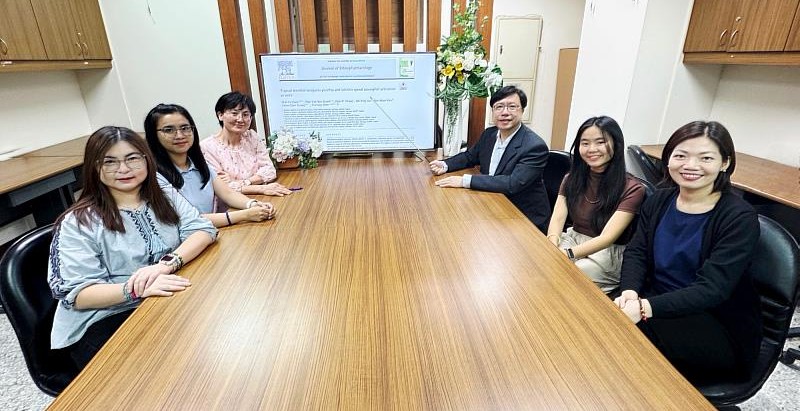
China Medical University (CMU)’s Traditional Chinese Medicine (TCM) research team, in collaboration with Tainan Municipal An-Nan Hospital, discovered that topical application of menthol on the forepaw of mice significantly reduced pruritic behaviors induced by common itch-provoking substances and inhibited microglial activation in the spinal cord. This finding reveals the central nervous system mechanism underlying menthol’s anti-itch effects. The study, titled “Topical Menthol Mitigates Pruritus and Inhibits Spinal Microglial Activation in Mice,” was published in the international journal Journal of Ethnopharmacology.
The research team noted that in animal experiments, topical menthol markedly decreased scratching behavior triggered by pruritogens. Remarkably, the effect occurred even when menthol was applied only to the palms or soles rather than directly to the itchy area. In addition to acting on cold-sensing receptors (TRPM8) in the skin, menthol appeared to suppress immune cell responses at the spinal level, potentially achieving anti-itch effects through a “neuro-immune modulation” pathway. This discovery links the cooling properties of traditional TCM ingredients with modern neuroscience, aligning with the recent surge of interest in the antipruritic and analgesic mechanisms of menthol.
The first authors of the study are Professor Shih-Ya Hung of Graduate Institute of Acupuncture Science, CMU and Vietnamese Ph. D. student Tran Van Bao Quach, while the corresponding authors are Director Yi-Hung Chen of International Master Program in Integrative Health, CMU and Director Chien-Chen Huang of Department of Chinese Medicine, Tainan Municipal An-Nan Hospital.
Professor Yi-Hung Chen stated, “Our research shows that applying 8% menthol to the forepaw of animals effectively reduces scratching behaviors, and this effect is at least partially mediated by decreased activation of spinal microglia. This highlights the potential of cold-sensing receptors as therapeutic targets for itch and supports the traditional use of menthol for soothing pruritus.”
He further noted that applying menthol to the limbs as a strategy for managing generalized pruritus is clinically feasible. Future studies will explore its underlying mechanisms in greater depth and evaluate its clinical applicability in different patient populations. Under the leadership of Director Lu-Hai Wang of Research Center for Traditional Chinese Medicine, CMU and Academician Jaung-Geng Lin, the team continues to advance innovation in TCM research; this study was completed over three years with support from the center.
Professor Shih-Ya Hung added, “By integrating concepts from TCM acupuncture with receptor-based pharmacological mechanisms, we used menthol—an activator of cold-sensing receptors—to stimulate peripheral nerves and stabilize immune cells in the spinal cord, thereby alleviating itching. Further experiments and clinical data are needed to substantiate these conclusions.”
Dr. Chien-Chen Huang also pointed out, “Menthol is a common topical ingredient in clinical practice. Our proposed ‘limb-application strategy’ is a promising direction, and its value will be further verified through rigorous clinical trials.”
The Journal of Ethnopharmacology (JEP), published by Elsevier and established in 1979, is a core journal in ethnopharmacology. It focuses on the pharmacological activity and mechanisms of human traditional medicinal resources, emphasizing scientific validation, reproducibility, and the ethnopharmacological relevance of research, which must be explicitly addressed in the abstract. As a leading journal in the international ethnopharmacology community, it has long published significant research in TCM and natural products.
中國醫藥大學與安南醫院團隊研究成果登上國際期刊《民族藥理學雜誌》
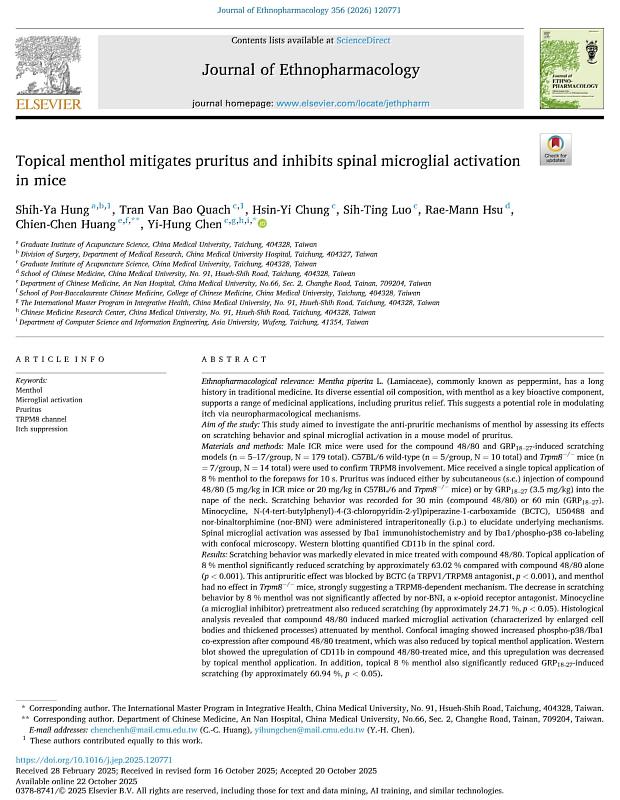
中國醫藥大學中醫研究團隊與臺南市立安南醫院合作進行研究發現,在小鼠手部外用薄荷醇,能明顯減少由致癢物引發的搔癢行為,並抑制脊髓內的微膠細胞(microglia)活化,揭示薄荷醇止癢的中樞神經機制。這項研究成果「外用薄荷醇減輕搔癢並抑制小鼠脊髓微膠細胞活化」(Topical Menthol Mitigates Pruritus and Inhibits Spinal Microglial Activation in Mice)論文發表於國際期刊《民族藥理學雜誌》(Journal of Ethnopharmacology)。
研究團隊指出,在動物實驗中,外用薄荷醇能顯著降低由常見致癢物引起的搔癢行為;即使沒有塗抹在癢的部位,只塗手掌或腳掌也有效果。薄荷醇除了作用於皮膚的冷覺受體(TRPM8),還能抑制脊髓層級的免疫細胞反應,可能透過「神經-免疫調節」途徑達到止癢的效果。這項發現將傳統中醫的清涼成分與現代神經科學連結,呼應近年對薄荷醇在止癢與鎮痛機制上的研究熱潮。
這篇研究論文的第一作者為中國醫藥大學針灸研究所洪詩雅教授與越南籍博士生郭文寶珍;通訊作者則為中國醫藥大學國際整合健康碩士學位學程主任陳易宏教授,以及臺南市立安南醫院中醫部主任黃千甄醫師。
陳易宏教授表示:「我們的研究顯示,將8%薄荷醇外用於動物前足,能有效減少搔癢行為,而其效果至少部分是透過減輕脊髓微膠細胞的活化。這突顯冷覺受體作為搔癢治療潛在靶點的可能性,也支持傳統醫學中以薄荷舒緩搔癢的經驗。」
他進一步指出,將薄荷醇塗於四肢作為治療全身性搔癢的策略,具有臨床可行性。未來研究將進一步探討其作用機制,並評估在不同病人族群中的臨床應用潛力。中國醫藥大學中醫藥研究中心在王陸海院士與林昭庚院士領導下,持續深耕中醫創新研發;本研究即在該中心的支持下歷時3年完成。
洪詩雅教授說:「我們結合中醫針灸的概念與藥理學的受體機制,利用能活化冷覺受體的薄荷醇刺激周邊神經,以穩定脊髓免疫細胞,達到減輕搔癢的效果。相關推論仍待更完整的實驗與臨床資料支持。」
黃千甄醫師指出:「薄荷醇是臨床常見的外用成分,我們提出的『四肢塗抹策略』,是一個可行的方向,未來將透過嚴謹的臨床試驗進一步確認其應用價值。」
Journal of Ethnopharmacology《JEP》期刊為Elsevier出版、1979年創刊的民族藥理學核心期刊,專注於人類傳統藥用資源的藥理活性與機制研究,強調傳統知識的科學驗證與可重現性,並要求在摘要中闡明研究的民族藥理學意義(Ethnopharmacological relevance)。該期刊為國際民族藥理學領域的重要指標期刊,長期刊登中醫藥及天然物研究的重要成果。
Reference: https://www.cna.com.tw/postwrite/Chi/417488